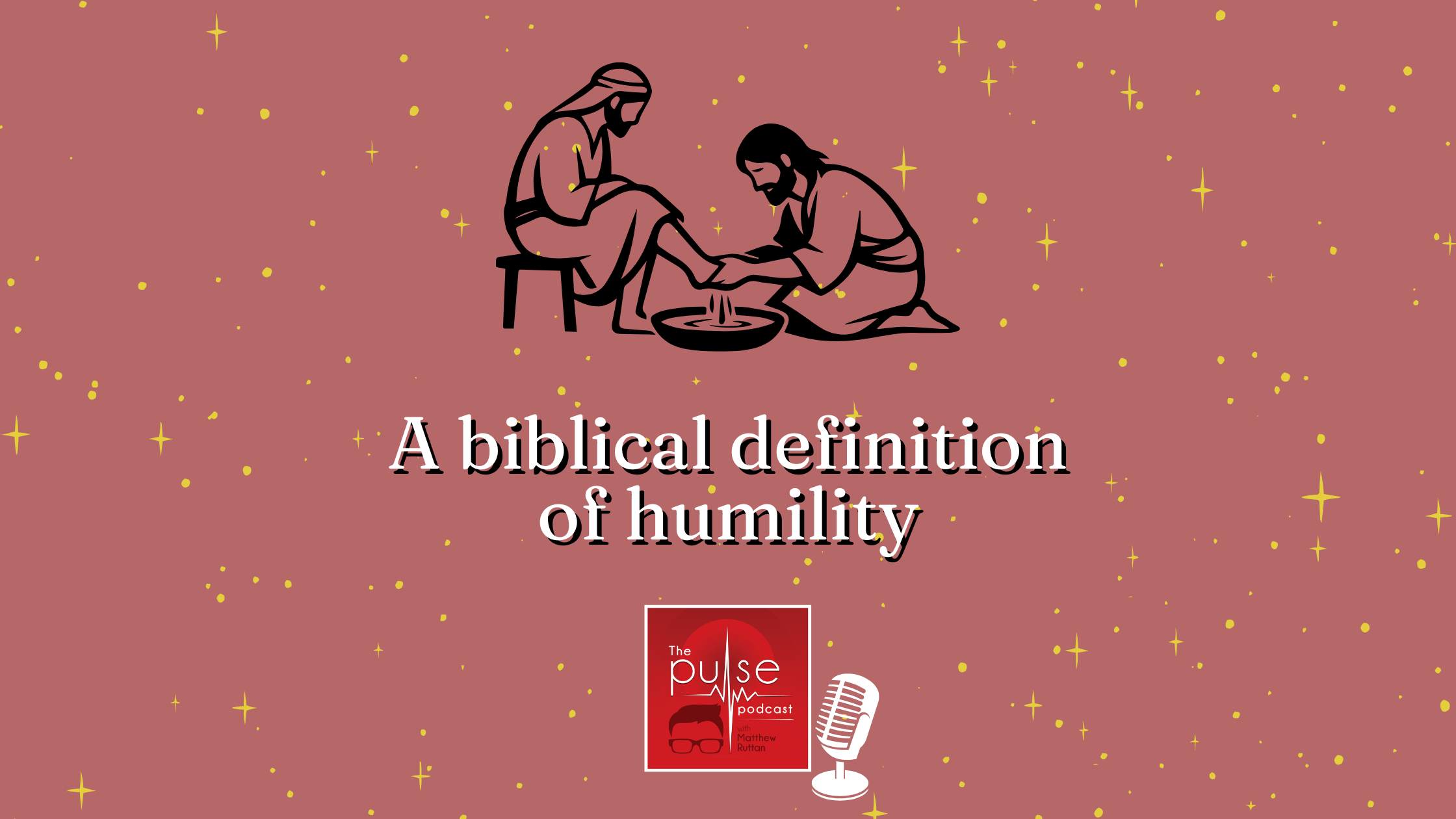
Vices and virtues
In the Bible, there are virtues and there are vices. These are traits to cultivate, and traits to purge.
In the sixth century, Pope Gregory the first curated a list that we know today as the “seven deadly sins.” Pride was first on the list. Its corresponding virtue was (and is) humility. But if pride is so bad and humility is so good, what is it?
This episode will provide a definition which, I believe, is faithful to how the word is used in the Bible. Speaking of which, here are a few of the times it is mentioned.
Biblical examples
In James 4:10 the half-brother of Jesus says: “Humble yourselves before the Lord, and he will exalt you.” The apostle Peter says something similar in 1 Peter 5:6. Both of these statements echo Jesus’ own words in Matthew 23:12: “Whoever exalts himself will be humbled, and whoever humbles himself will be exalted.”
Proverbs 3:34 says: “Toward the scorners he [God] is scornful, but to the humble he gives favor.” That verse was so well-known that it is alluded to in two other places in the New Testament.
Further, there are times when the humility of a biblical character is celebrated. One example is Mary in Luke 1:46-55, a passage famously known as the Magnificat. Another is Jesus himself in Philippians 2:5-11 where we are told to be like Jesus who: “humbled himself by becoming obedient to the point of death, even death on a cross” (verse 8).

Definitions
When it comes to zeroing-in on a definition, the Thayer lexicon says that it has to do with littleness, modesty, and even lowliness of mind. Interestingly, it mentions that the word for humility is very rarely used by secular writers outside of the Bible at the time, and when it is, it is used negatively. This already tells us that there is something counter-cultural about the biblical ideal of humility.
The Friberg lexicon includes the ideas of voluntary submission and selflessness. In light of what we know about Jesus, that makes sense. Literary critic and author C.S. Lewis picks up on this when he says: “Humility isn’t thinking less of yourself, but of yourself less.”[i]
I’ve also become fond of an insight by Henri Nouwen. He pointed out that we live in a society that values upward mobility. Think of the “ladder of success”—which, by the way, seems to imply stepping over other people in the process. In contrast, Nouwen coined the phrase “downward mobility.”[ii]
That’s good. And it leads us into a definition that I think is faithful to the biblical picture: Humility is being down-to-earth and unpretentious as you yield to God for the benefit of others.

Let’s break down that definition one idea at a time.
First, the English word “humility” is connected to the word “humus,” meaning ground or soil. This is where the ‘down-to-earth’ part comes from. It’s seeing things as they really are, in a way that is honest and on the ground-level, without pretense or show.
Second, this definition makes it clear that humility includes yielding to God. The opposite of humility is pride and arrogance; these presume to know better than the Lord does. However, we exist for God, not the other way around. This phrase makes that clear.
Third, we live this way for the benefit of others. This is the opposite of being self-serving. The Great Command is about loving God and the people around us. It is focused outward, not inward. This was certainly true for Christ, and it can be true for us as well.
Tim Keller points out that in this there is a measure of self-forgetfulness. We become so centred on God that we become less and less concerned with our reputation or what other people think.[iii]
Here’s the definition again: Humility is being down-to-earth and unpretentious as you yield to God for the benefit of others.
Is it just me or is humility downplayed as a modern virtue? Perhaps this is because humility has become confused with getting walked all over or being taken advantage of. But those are different things. I think that people who are truly humble hold within themselves a powerful confidence. After all, they don’t feel the need to bring attention to themselves or be first in line. They know they are first and foremost serving God. They have an ultimate audience of One.
Humility and spiritual warfare
In addition to a deep inner confidence, humble people are also generally more successful when engaged in spiritual warfare. Our Adversary—Satan—can exploit our pride to gain influence over us, just as he can exploit our anger, unforgiveness, or dabbling in the occult or false religion. Humility is an antidote to the Devil. It’s not the only ingredient in this battle, but it’s certainly critical.
In his book Unseen Warfare, Lorenzo Scupoli writes: “For how can grace, which comes to help and enlighten us, enter that man, who thinks of himself that he is something great, that he himself knows everything and needs no outside help?—May God preserve us from this disease and passion of Lucifer!”[iv]
Scupoli calls pride a disease. He also calls it a “passion of Lucifer”! Why? Because it helps his cause, not yours. Pride pushes God away, but humility yields to his rule. The Devil doesn’t want you to focus on him only. The devil wants you to focus on you, because the more you are focused on you, the less you are focused on God.
Greatness
Since we live in a world that is soaked and saturated by a desire for bigger-better-more—not only in our driveways, bank accounts and social media audiences, but in our mirrors—we constantly need to be reminded about how Jesus defined greatness. And yes, you guessed it, it isn’t what most people think.
In Mark 9, the disciples were arguing about who was “greatest.” Jesus responded by saying: “Anyone who wants to be first must be the very last, and the servant of all” (verse 35). According to Jesus, true greatness is servanthood. To be clear, humility is often seen as weakness in the eyes of the world, but it is seen as greatness in the eyes of God.

Topsy-Turvy
When I was young, we would sometimes read the Mr. Men books. One of them was Mr. Topsy-Turvy. Things were very unexpected in his world. His curtains hung downside up instead of right side down. He said “Morning good,” instead of “Good morning.”
I can only imagine that Jesus came across in much the same way to many people, but in a more profound way. He turned their expectations upside down. As we know from reading the New Testament, this is often the way when it comes to the Kingdom of God. Selflessness instead of selfishness. Love instead of la-dee-dah. Grace instead of blame. Truth instead of excuses. Following Jesus instead of the crowd.
Humility is being down-to-earth and unpretentious as you yield to God for the benefit of others.

Subscribe wherever you enjoy podcasts:
[i] Quoted by Tim Keller on Twitter, June 20, 2013. In the comments, he suggests that his quote is a paraphrase of something he read in one of Lewis’ books. The original thread of the Tweet is here.
[ii] Henri Nouwen, In The Name of Jesus (New York: Crossroad, 1989), 92.
[iii] Keller speaks to this in his sermon called “Humility” through the Gospel in Life Podcast. It was delivered at Redeemer Presbyterian Church on May 23, 2010.
[iv] Lorenzo Scupoli, Unseen Warfare as edited by Nicodemus of the Holy Mountain and revised by Theophan the Recluse, trans. E. Kadloubovsky & G.E.H. Palmer (Crestwood: St. Vladimir’s Seminary Press, no year given), 82.
Leave a Reply