

In this podcast episode and blog, I’d like to respond to something I sometimes hear. Perhaps you’ve heard it too. Who knows—maybe you’ve even said it.
Here it is. “There are so many Christian hypocrites—they say they follow Jesus but do and say things that show they don’t. The whole thing is bogus.”
At first, these kinds of statements seem somewhat persuasive. After all, hypocrisy is bad. Jesus himself speaks against it on multiple occasions. Doesn’t it disprove the faith if a lot of people don’t live by its own teachings?
To answer this, I’d like to use a simple illustration which I hope is memorable for you—so easy-to-remember that you can use it yourself. After, I’ll provide some further explanation.
Here’s the simple illustration. “Is it the road’s fault if a drunk can’t stay out of the ditch?”
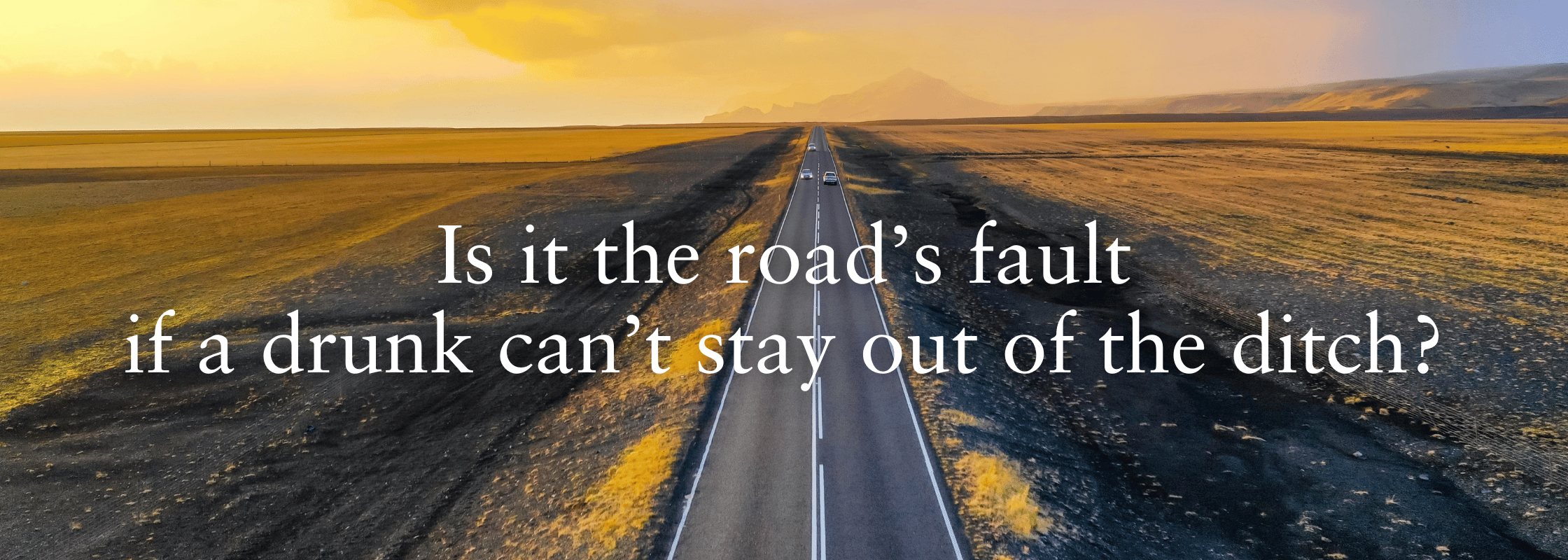
I think this is helpful because Jesus says that following him is like a “road” or “way” (Matthew 7:13-14). Most people, he says, take the wide and easy road. However, his path is the one of faithfulness, truth and loving self-sacrifice. He himself lived this way. Not only did he talk the talk, but he walked the walk. His path is simply there to be taken and lived.
In my illustration, I mention a drunk person who has trouble staying on the road because, well, he’s drunk. He has become impaired. He isn’t seeing straight. He swerves this way and that way. He can’t keep it together long enough to stay on the road.
In this scenario, is it the road’s fault that the drunk can’t stay on it? Of course not.
I think this is a helpful way to think through the claim that hypocrites disprove Christianity’s credibility. Is it the fault of a game of baseball if a bunch of slackers don’t play it very well? No.
Before I explain more, let me first say that, yes, hypocrisy is not good. It should concern all of us. In Matthew 23:28 Jesus confronts the scribes and Pharisees (who were a certain kind of religious leader in the first century). After he calls them hypocrites to their faces, he says: “So you also outwardly appear righteous to others, but within you are full of hypocrisy and lawlessness.” In other words, they want to look religious and impressive on the outside, but on the inside they are unchanged.
Central to Christianity is the teaching that we are all sinners. This isn’t undue negativity; it’s the plain truth. We have, as Paul famously stated in Romans 3:23, all sinned and fallen short of God’s glory. We mess up, daily. We think, say or do things we shouldn’t. We have ups and downs, and a million moments when we need to ask God for forgiveness and to help us begin again.
We really do need to remember that, especially after we’ve had a good couple of days and start to think, ‘Hey, maybe I am in fact better than all of these other slouches.’ However, we are, in this life, and in the words of Ruth Graham, “under construction.”[i] So yes, hypocrisy is something we need to work at expunging from our own lives with the help of God’s Spirit. When it comes to faith we want to be whole-hearted, not partial-hearted.
At the same time, when people raise the topic of hypocrisy amongst Christians, we can use it as an opportunity not only to admit that it’s a problem for all of us, but to remind one another what—and who—Christianity is all about: Jesus. Only he is perfect. He is the only one who has not sinned (Hebrews 4:15). It’s called Christ-ianity, not you-ianity or me-ianity.
This topic can also be an opportunity to highlight something else that is central to our faith: grace. A well-known definition of grace is that this is God’s “unmerited favour.” I like to say it is generosity we don’t deserve—but which, through Christ, God gives to us anyway. We are forgiven and made right with God not because we are moral superstars—we’re not!—but because of what Jesus has done for us on the cross. Paul speaks to the necessity of God’s grace very clearly in Ephesians 2:8: “For by grace you have been saved through faith. And this is not your own doing; it is the gift of God…”
I should also mention that when people say Christianity is somehow lacking because not all Christians are doing a good job, they probably have a few very specific people in mind. Perhaps they are thinking about an obnoxious friend who keeps quoting the Bible but is very un-gracious in his or her own actions. Or perhaps they are thinking about a public figure who has abused their position and influence, or a family member who turns everything into a soapbox and makes family meals an uncomfortable experience. Fair enough. Jeff Medders offers a warning: “We may love rejoicing in the truth, but if we are unkind, our pants are on fire.”[ii]

When we are reminded about the many people in the ditch, we should also remember the scores of normal every-day people we know who are faithfully following Jesus. They are praying, reading their Bibles, serving others, going to church, volunteering, making sacrifices for others behind-the-scenes, respectfully sharing the good news, and seeking God’s will. Although none of them are perfect, it’s good to recognize that not everyone is in the ditch all the time. There are in fact people on the narrow path, even if naysayers are slow to admit it.
As I bring this to a close, let’s return to the simple illustration we started with: “Is it the road’s fault if a drunk can’t stay out of the ditch?” Of course not. In a similar way, is the road of Christ to blame if some people don’t follow him very well? Of course not. Sure, it’s a problem. But it doesn’t discredit the road—and it certainly doesn’t discredit Christ.
Tim and Kathy Keller have a great word on which to end. It has to do with honestly looking in the mirror as we try to be whole-hearted—not partial-hearted—in our discipleship. It comes to us in the form of a prayer: “Show me the specific gaps between my faith and my practice, and empower me to close them.”[iii]
May each of us, with God’s help, become more and more like Christ, with increasing sincerity and integrity, and may each of us take seriously the narrow path of upward glory.

Subscribe wherever you enjoy podcasts:
[i] Ruth Graham was the wife of Billy Graham, the well-known preacher and evangelist. One day while driving through a construction zone and seeing a sign that said “under construction,” she likened that to our human experience. Her tombstone says: “End of construction—thank you for your patience.” I was able to see it in person several years ago.
[ii] Jeff Medders: Humble Calvinism (The Good Book Company, 2019), 25.
[iii] Timothy Keller with Kathy Keller, The Songs of Jesus (New York: Viking, 2015), 107.

Thoughts?